
Just a quick teaser. More materials (photos, sheets, videos) are coming soon. Don’t forget to subscribe to the mailing-list of Platform Parallel Netherlands to hear about more events around parallel programming in the Netherlands. Click on the icon at bottom-right to watch the…
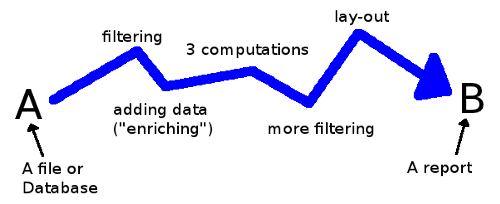
StreamComputing is 2 years old! A personal story.
More than two years ago, on 13 January 2010, I wrote my first blog-post. Four months later StreamComputing (redacted: rebranded to StreamHPC in 2017) was both official and unknown. I want to share with you my personal story on how I got…
AMD gDEBugger 6.2 for Linux
The printf-funtion in kernels isn’t the solution to everything, so hence profilers and debuggers specially tailored for GPU-programming. On Windows there is a lot of choice, but mostly only if you have a paid version of Visual Studio. On Linux you have…
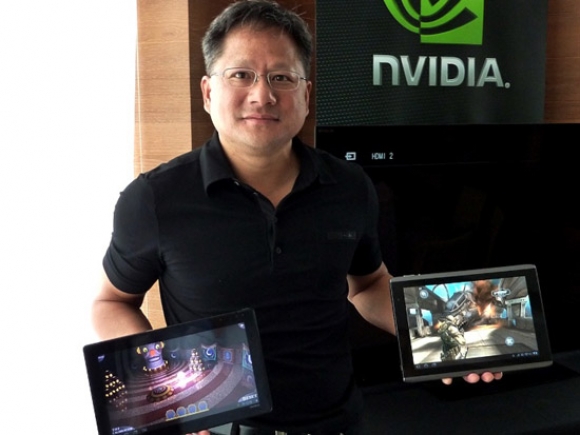
NVIDIA: mobile phones, tablets and HPC (cloud)
If you want to see what is coming up in the market of consumer-technology (PC, mobile and tablet), then NVIDIA can tell you the most. The company is very flexible, and shows time after time it really knows in which markets…
Neil Trevett on OpenCL
The Khronos Group gave some talks on their technologies in Shanghai China on the 17th of March 2012. Neil Trevett did some interesting remarks on the position of NVidia on OpenCL I would like to share with you. Neil Trevett is both…
USB-stick sized ARM-computers
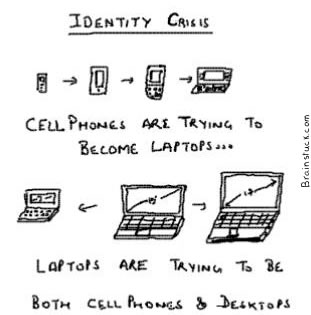
Now that smartphones get more powerful and internet makes it possible to have all functionality and documents with you anywhere, the computer needs to be reinvented. You see all big IT-companies searching for how that can be, from Windows Metro to…
PDFs of Monday 16 April
By exception, another PDF-Monday. OpenCL vs. OpenMP: A Programmability Debate. The one moment OpenCL and the other mom ent OpenMP produces faster code. From the conclusion: “OpenMP is more productive, while OpenCL is portable for a larger class of devices. Performance-wise, we…

5 types of loops you should avoid
In “Separation of compute, control and transfer” I talked about node-wise programming as a method we should embrace instead of trying to unroll the existing loops. In this article I get into loops and discuss a few types and how they…
Supporting OpenCL on your own hardware
Say you have a device which is extremely good in numerical trigoniometrics (including integrals, transformations, etc to support mainly Fourier transforms) by using massive parallelism. You also have an optimised library which takes care of the transfer to the device and the…
Separation of Compute and Transfer from the rest of the code.
In the beginning of 2012 I spoke with Patrick Viry, former CEO of Ateji – now out-of-business. We shared ideas on GPGPU, OpenCL and programming in general. While talking about the strengths of his product, he came with a remark which I found important…

StreamHPC flirts with ARM
With the launch of twitter-channel @OpenCLonARM we now officially show a strong interest in ARM for compute. And we are not the only ones, as the twitter already has 80 followers (60 in 1.5 day and 12 retweets of the welcome-message)….
AccelerEyes ArrayFire
There is a lot going on at the path to GPGPU 2.0 – the libraries on top of OpenCL and/or CUDA. Among many solutions we see for example Microsoft with C++ AMP on top of DirectCompute, NVidia (and more) with OpenACC, and…
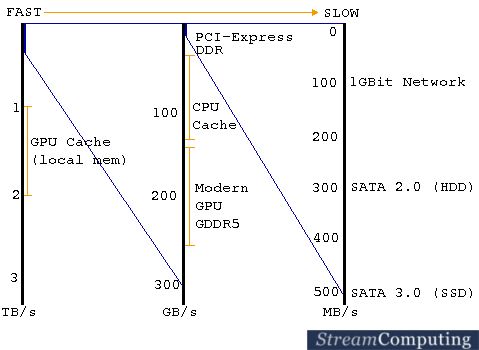
Theoretical transfer speeds visualised
There are two overviews I use during my training, and I would like to share with you. Normally I write them on a whiteboard, but it has advantages having it in a digital form. Transfer speeds per bus The below image…